Showing posts with label Delhi. Show all posts

Tuesday, October 26, 2010

Urban poetry

 The metro station is familiar territory but it is cold and impersonal. It’s all shining steel, hard stone and bright lights. It is also arms, legs, heads, hair, skin, breath and sweat. But it is here that some fleeting moments of sheer beauty are created by chance. Right here, in the spaces between bodies, stone and metal.


Walking into this cavernous underground labyrinth stuffed full of flesh and things, I am drawn to this couple. Their hands are moving, but their mouths only just. It’s as if someone filtered out all the noise and what is left is pure communication – stretched mesmerizingly thin around them like the rainbow-surface of a soap bubble. And in this bubble around them the space seems to expand with each gesture-for-word. Theirs, I realize, is a silence, which in the absence of words is more than just a lack of sound. It’s an abundance of calm. They talk without speaking. And all around them are words being spoken, yet nothing is being said.

And then there is me.

Smiling like a fool, overjoyed at this urban poetry being written a few hundred feet under the earth, set to music by trundling trains of gleaming silver.

So what is it about a mundane metro commute and two people talking to each other in sign language, that is so unspeakably poetic? It’s like a missed heartbeat in the racing pulse of life in the city. Exhilarating, this precious pause.

Saturday, May 23, 2009

Midsummer Mayhem: storms, broken trees and other such unearthly pleasures


the late bloomer: Rajpur Road, Civil Lines


"The rain fell like applause"

- Signature by Michael Ondaatje (From the Cinnamon Peeler)


Finally.


Delhi got the sound and light show it deserves.


No. I’m not referring to the one at Red Fort set to Amitabh Bachhan’s baritone or the one at Purana Quila narrated by Om Puri. (Ironic isn’t it – that the fort built in a time of excess gets the decadent voice of Bacchan while the crumbling, deeply neglected Old Fort has its story told by his doppelganger Puri – just a thought)


Coming back to what I was saying. We were treated to three incredible albeit short-lived thunderstorms in the span of two weeks. And what drama it was - certainly worth the wait. Sepulchral clouds on the horizon, swirling dust, winds that made light of even the mightiest Neem and raindrops that felt icy on sun-baked skin. Thunder sounded a preliminary warning and people scurried like ants, looking for cover. The rumble set the stage with a fantastic drum roll. Whooshing gusts of wind threatened to spirit away trees, birds, things and people alike. Lightning that scared the bejesus out of me with its white whip cracking across the night sky. Even hail that fell like marbles out of tin box!


And finally rain. Delicious, smelling-of-earth, soak-you-to-the-bone, redeem-the-month-of-may kind of rain.


But for me the best part is when the grand show is over. The time when the damp air and sweet smells filling it can be imbibed without prejudice. When people (some people at least!) survey in shock and awe, the arboreal carnage across the city. Huge branches, entire trees, piles of leaves, flowers, pods and nests litter the roads. A fitting homage.


I got to take in the sights on my regular rickshaw ride from the metro station back to my house. The road is particularly beautiful winding up from Shamnath Marg flanked by the pristine white façade of the British built Maidens Hotel, rising up towards St. Xavier’s and the Governors residence and finally ending at a junction framed by Oleander and Jarul trees. Near the hotel, a tall eucalyptus tree had been felled by the storm, and a small army of men and women were at work trying to clear the road. Most of the leaves had been turned to mulch by the speeding vehicles. A happy accident in my opinion because the whole place smelled divine – aromatherapy in the most unlikely fashion!


Further ahead, near the beautiful St. Xavier’s school, a massive branch of Neem had broken off. Almost half a tree. As the rickshaw pulled past the giant green bush on the road I caught a glint of steel underneath. A silver Esteem barely visible, seemed to be resting, virtually unharmed under the canopy. The next day the whole thing was gone – stripped for daatun and its medicinal leaves and bark I bet – or for firewood. I remember soaking in a bath of neem leaves when I was down with Chicken Pox as a kid. To my mind, it’s the closest I’ve come to a spa treatment till date. I’m telling you – Cleopatra might have bathed in milk but I’ve had itchy sores healed by a bittersweet broth of leaves.


Anyway, the rickshaw ride had many more sights for me to savour. The purple flowers of Jaarul, magenta Bougainvillea trellis over a wall, the wet red brick building of B.M. GangeSchool and finally the flaming Amaltas (laburnum) tree in my own house compound. When May began, I was worried. The Amaltas tree I loved to watch, was still bare. In the rest of the city, they had already begun to show off their dangling yellow bunches. This one was bald except for a few new shoots. I thought the mindless pruning of its branches by the neighbours had finally been its undoing, as I had often feared. But as it turned out I was being paranoid. It was just a late bloomer. And like all late bloomers, when it finally did come into its own, it outdid all its golden siblings across town. I should’ve known – our family has a real thing for late bloomers.


These things – part of nature’s very own Cirque du Soleil - invoke in me what I imagine to be the closest thing to religious fervour and passion. A constant reminder that it takes so little to lift ones spirits. For me it takes a dash of good weather and a smattering of crushed eucalyptus leaves put together with a burst of yellow laburnum.

Sunday, January 25, 2009

Winter Wonderland


Winter in Delhi is many things. Bitterly cold, sun-less and bleak for the most part it can be an unhappy time for many. For me though, the city shrouded in mist is a happier place. Happier than the Delhi of April and May – when bathing defeats its own purpose and the tarred roads melting in protest, stick to your shoes. Happier than the city in monsoon when complaints are rife of potholes and puddles. No. Winter is relief.


And what an entrance it makes! Easing its way into our lives with a shudder here and a shiver there. Not like spring that reminds of the oppressive summer heat lurking ahead. Long hot days give way ever so gently to shorter days when the cool air brings goosebumps on bare arms. Night sneaks up on the day and the light fades dutifully. The sun doesn’t hurt anymore – its warmth spreading deliciously over skin bare now but soon to be hidden under warm layers. Soon instead of the once-a-week Chocobar, it’s warm smoky peanuts and seeking out the un-earthly pleasure of cracking their crunchy shell under thumb and forefinger. The city is changes its hues – Tilak Marg will be flanked by a skeletal army of trees. Trees that jealously kept out the sun, now filter its rays and create winter ephemera.


Like I said winter in Delhi is many things.


It is the billowing white mist from my mouth. It is layers of wooly pleasure – scarves, gloves, multi-coloured socks, shawls, sweaters, stockings and neck warmers. It is going to lodhi garden to watch the dogs play and laze around in the fickle sun - just like everyone else. It is huddling in an auto sharing a shawl while the wind makes light of your chattering teeth. It is waking up in the dark (when we were young) to go to school. It is a bonfire of dry leaves that dies out almost as soon as it is lit. It is the haze that hangs low on the empty streets at night and the halo that crowns the tall lights along the way. It is dahlias and chrysanthemums. It is lumpy quilts wrap around frigid toes and a frosty nose. It is sun-kissed mornings and plump oranges with tangerine jewels. It is the smell of freshly washed woolens and their fuzzy warmth baking in the sun. It is fallen leaves crackling underfoot and the smell of wood smoke.


To me winter in this city will always smell of burning leaves. Perhaps it is because until a few years ago these autumnal-discards were burnt in neat little piles along the roadside. The pungent acrid smell tickled the back of my throat. But mixed with the winter air, it felt cold but smelt of warmth. A warm woody fragrance that would get into my clothes if I got close enough to these winter pyres.


R shares my joy for the cold season. And though hers is a sartorial obsession we were equally excited about the steadily dipping mercury. One evening as we sat in auto speeding down Siri Fort road, considering the nip in the air with apt concentration R said something…..wonderful.


Don’t you think people seem a lot friendlier in winter?


Hmm. Why do you say that?


All this road rage and rabblerousing….it’s because in the summer everyone is so hot and bothered. But in winter…it’s so cold that people can’t be bothered about sticking their noses out of their monkey caps, let alone open their mouths to say something vile.


….I think you’re on to something.


I can’t wait for it to get so cold that my knuckles get jammed! says R here eyes the size of saucers. Hey, move over so I can get under your shawl. My nose is cold.


As we cowered in oner corner of the auto almost cheek-to-cheek with bare chested Sallu bhai, I caught a whiff of wood-smoke from a park nearby. Winter had warmed my heart yet again.


Friday, May 30, 2008

Delhi Times

I have a bone to pick with this city.

What is it about Delhi that makes even the most demure, polite,well mannered people whip out their claws and bare their teeth?

Delhi is not for the fainthearted. It is exasperating, infuriating and tends to just rub people the wrong way. A colleague at work told me that a man consumed by rage (in all probability due to an altercation over a near-invisible dent on his precious vehicle) started chucking mini boulders at other commuters, damaging a small cavalcade of big cars and even bigger egos. Where he found boulders to hurl on a main road is a question worth asking. (Although my guess is it was thanks to the BRT/MCD/PWD/NDMC or some other acronym that makes good use of the taxpayers' money by digging up every square inch of motorable road) And anyway, the fact that he found it in him to do such a thing is perhaps mundane and would draw less attention than the question of availability-of-boulders-to-throw-at-errant-drivers.

These are the times we live in.

A time when violence is the new normal
A time when we split hairs over whodunnits while a nation becomes a republic overnight
A time when we ask the most banal questions with utmost sincerity....

....and leave it to someone else to bell the cat.

Tuesday, May 27, 2008

G.e.t R.e.a.l

It rained and I was happy. But I had reality shoved in my face by just another jackass - the rich kid with the big car - when he calculated the precise turn of the wheel that would splash just the right amount of murky rainwater to soak me down to the bone. Just when my head was a-buzz with rain-soaked laburnum and i-love-the-smell-of-wet-earth thoughts.

Assholes will remain assholes. Yes. Even on days when flowers that gladden your heart dance their mirth in front of your eyes.

Throw down the gauntlet.
Take the bull by the horns.
Wake up and smell the coffee.
Get real.

and Get Going.

Tomorrow is another day.

Monday, May 15, 2006

Orchestrations at a red light

" A city without a soul" , said a writer about the national capital. About delhi. About my home. Coming back to delhi after a long break was enough to have the wind knocked out of me. The city is undeniable in its insolence. It provoked me each time I confronted it. Each confrontaion left its mark. But each encounter brimmed with the possibility of a story......

The teeming millions were milling about right here on the ITO crossing. They leapfogged from Tilak Marg onto Sikandra road and onward to the local train that would take them home past the slums and shantytowns - wastelands beyond which lay towers of glass and cool air. But the teeming millions breathed the sticky air ripe with scent of sweat. The city breathed in tandem with the rhythm and pulse of traffic signals, the movement of buses and the chugging of the trains. And so the urban drama would play itself out - a silent musical with an unseen beat.

The old man clinging to his polythene bag for dear life, trying to brave the merciless traffic. The crude man beneath a veneer of sophistication in his big car, cursing the old man who totters shamelessly in front of his expensive self. The traffic policeman in his stuffy uniform who watches the charade and thinks of his tenement in choked West Delhi and the power cut that awaits him. The young college going girl, aimlessly chewing gum and ignoring leering men with studied indifference. the scrawny urchin who momentarily forgets to beg as he is distracted by the burst pileline under Tilak bridge that is spouting jets of water and wetting motorcyclists. The bus conductor who shouts destinations at his flock - the passengers - while chewing on his cigarette and simultaneously tearing those coloured bits of paper marked 2, 7 and 10 Rs. The daredevil hangs perilously from the footboard of the bus hoping the girl chewing gum will notice. The auto-driver ignores the boy and concentrates on his unsuspecting passenger who he has successfully fleeced. He adjusts his rearview mirror to get a good look at the smooth-skinned lady even as she inwardly rebukes her own insolent driver for not having showed up that morning. Visibly upset at being caught in the sweltering heat, she eyes this alien mass of humanity about her from behind her dark shades.

A sick boy throws up on the side of the bus. A rickshaw driver pulls up under the drooping laburnum tree and proceeds to doze off, apparently oblivious to the heat and the stench from the festering drain nearby. The man selling cold water out of a hand cart for Re. 1 only, pours himself a glass of water. The old man has made it to the other side of the road. The traffic signal blinks green, everyone moves on gratefully. Elsewhere, a biker picks a fight with an autowallah. A cyclist wins the fight.

Friday, April 28, 2006

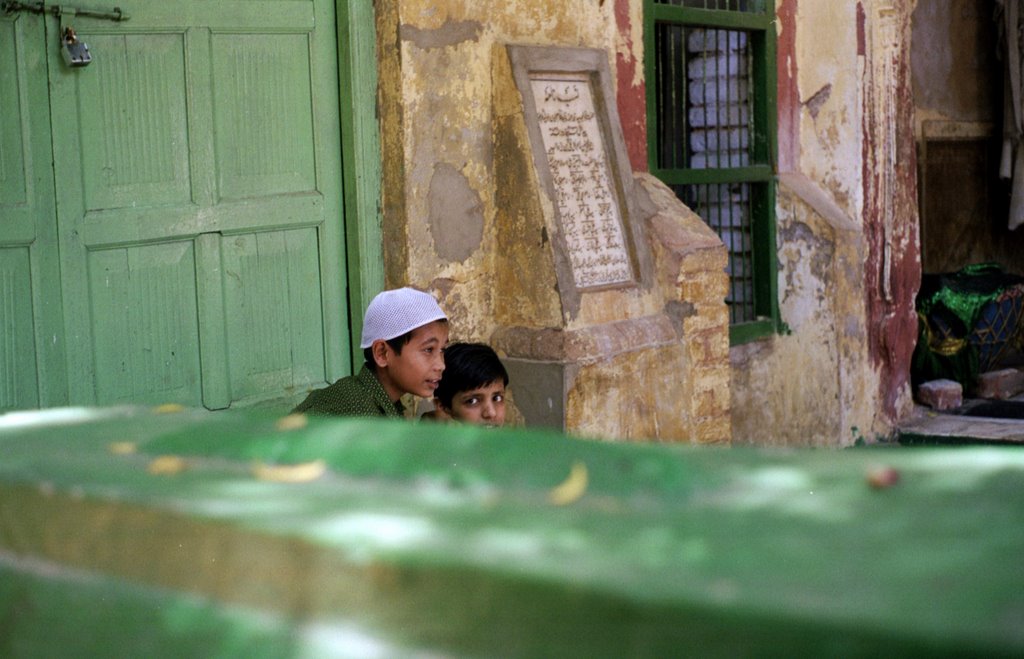
Nizamuddin Dargah May 2005

Ahmad Raza, along with a friend, watches the crowds in front of Amir Khusro's shrine at Dargah-e-Nizamuddin, New Delhi. This picture was part of a photo essay that I did for my Field Study. You can check out more pictures at www.flickr.com/photos/thinkaloud/ .

I used a Pentax K 1000 (which belongs to my father), Fuji crystal 200 ASA film and a telephoto lens. I am a patron of analog photography. Its so tactile!

Songs of the Mystics

It is impossible for even the whimsical visitor to remain untouched by the energy and vitality of the Dargah. It is in every way an assault on the senses from the moment you enter the crowded lanes till the time you leave the complex. One dare not hurry through it all lest one misses a whisper from beyond the grave. Turn a corner and Mirza Ghalib rests in an unfortunately unnoticed complex. Stop for a moment and you might be waylaid by the insistent perfume seller. "You must try Khus today", he says. Little grubby urchins with an impish sparkle in their eyes tug at your clothes. "Spare a rupee in the name of Allah!" The heaps of roses, the bright green chadors and the pulsating throb of the crowd engulf the unguarded visitor. Just when it seems too overwhelming the first strains of a Sama (traditional Sufi musical assembly) in full swing reach ones ears. That is what one came for. The calm within, despite the chaos without is always a welcome surprise. The Sufi way has revealed itself already. Order in chaos, unity in multiplicity.

Littered with the graves of long forgotten saints and dusty ancestors, the small complex betrays its many liaisons with the ghosts of yesterday. A vagabond mogul and a beloved princess share the same space (if not the same glory) as the mighty poet and his mentor. Many lives thrive within these walls. Some have made this place their home simply for sustenance, others in search of emotional and spiritual reassurance. But each one whatever be the purpose, is tied to the other in their acknowledgement of that Truth that none can deny- the truth of the Universal Spirit. The core of being itself that unites all things on earth. It is this that one sees embodied in the myriad faces of the Dargah-e-Nizamuddin. The water- bearer, the flower seller, the shoe keeper, the qawwal, the fakir, the pir, the sheikh, the pagan, the Hindu, the Mussalman, the rich, the poor, the woman, the child, the old, the young, the dead and the alive. Sufism is a prism through which the unity in the multiplicity of Beings becomes plain for all to see.

The crowd that throngs at the gates of Dargah-e-Nizamuddin each day bears testament to the living legacy of Nizamuddin Auliya and Amir Khusro, and also to the continuing relevance of Sufism. As a poet has rightly said, "In these senseless times a faith that makes you look within is a faith that makes sense". Synonymous with Sufism in India, Nizamuddin Auliya and Amir Khusro stand for values such as tolerance and humanism. Khusro’s contribution to poetry and music is not unknown. His verses have often been a eulogy of a country that he likens to heaven on earth, and a celebration of the diversity of Hindustan. His devotion to his teacher, Nizamuddin Auliya is unmistakable in his work.

I shall be set free from the bonds of the two worlds

If you become my companion for a while.
By your wanton playfulness you must have destroyed
Thousands of hearts of lovers like that of Khusrau.

What is remarkable is that Amir Khusro is perhaps more alive today than his mentor. It is customary at the Dargah to visit the smaller (but no less significant) shrine of Amir Khusro before proceeding to the main shrine of Hazrat Nizamuddin Auliya. Khusro lives in the innumerable verses, riddles, qawwalis and sayings he penned. He was indeed an ambassador of an India that was assimilative and inclusive. The foremost exponent of a spiritual and literary movement that rose above parochial concerns to reflect a truly cross-cultural sentiment.

Love is the only intoxicant in these mystical alleys. A sublime truth; the eternal and immortal soul of being itself. It rests beneath pearly white and swathes of green velvet. Poetry has been put to rest forever in the company of He who inspired it. These marble walls do not bind him. These bloody roses do not bury him. He rises out of his stony grave each time a single voice of the many reverberates through the air. They seek him in pleasure and they seek him in pain. They seek him in ecstasy and they seek him in despair. He seeks no one and yet he turns none away.

A timid strain at first; a lilting melody. Crowds melt into oblivion. No one is spared the tyranny of love. It consumes the self in its wake leaving only the soul. Cleansed, pure, pristine, provoked by passion and yet forever at peace. The words float above, over, under, around and through the crowd, wrapping themselves around the agony and the ecstasy of those who give themselves freely in love. Spirits leave their fleshy confines and come alive in the guise of the flourish of a dervish’s skirt or the solitary tear on a weather-beaten cheek. They take forms so delicate that they defy the cacophony that inspired them.

The attraction of love won’t leave you unmoved;

Should you not come to my funeral, you’ll definitely come to my grave.
My soul has come on my lips
Come so that I may remain alive

After I am no longer - for what purpose will you come?

For some the shrine is the beginning of a life anew whereas for some others it is the culmination of a journey that has brought them closer to achieving a desired state of rest. Ahmad Raza, 8 years old, has left his home in Bihar to come and live with his uncle. He is the boy who collects the empty flower baskets and takes them back to his uncle's flower shop. He knows Nizamuddin like the back of his hand and his eyes betray the many stories that he has to tell. He looks at my camera with curiosity and bewilderment. "What can you see through it? Can I see what you see?" Obviously he knows something I don’t.

The water bearer has seen it all. He has seen the compound choked with people the day riots broke out in Gujarat. They came in droves, he whispers. Some held on to each other while others wept by the grave of their saint, their confidante. Baba Khusro listened to them all. Khusro ki marham jaisi is duniya mein aur koi nahi. Where are you from, he asks. Do you have something to say to Him too? I have come from Ahmedabad I say. And I have come to listen to Him and his people. God bless you, he says. We share a smile and already a moment has transpired between two strangers - a moment of compassion, a moment of truth.

Death is not to be mourned. Rejoice in death for it is death that will unite you with your Beloved. Let me die before I die! Urs is the death anniversary of the Sufi saint and it is celebrated with much pomp and glory. It was my privilege to witness one such celebration. Crippled as one is by the insufficiency of language and the inadequacy of words, it is futile to attempt to describe an experience such as this. To say the least it is a world where you are defined by what you feel and not by what you know. Look around and it is plain to see. A lone voice rises above the crowd. It is some tune you haven’t heard. But listen to it you must. Twilight approaches and the crowd is like viscous glue. The summer air, thick with incense is about to get thicker with the songs of Love. The Qawwali begins without warning. Before you know it your hands join the others in the maddening rhythm. Soon it has made a fanatic out of you. But you stand still while these waves break over you with unending force until you are spent. You wonder, what is the diaphanous glow that has suddenly come over all that you see? Blink. The glow clears as tears flow free.

The journey of the mystic is a tremulous one at first. But only to be transformed, with time, into the confident stride of the seasoned traveler. There are no tourists in these quarters, only wanderers who need no maps, who in fact despise all maps. The journey then is a journey within, an inexorable quest. Who can say what the end shall be in a journey such as this? But the rewards are plenty. Love, compassion, humanity, universal brotherhood, the innate potential of every being to reach a higher state of existence and the realization that God is after all a mirror of the Self, are what drive the Sufi towards greater consciousness. The Sufi proclaims in all earnest: love is the cause of all creation. Love of God is the love of humanity, because to love god is to love all that He has created.